
NEI Corporation receives new Patent Allowance
October 8, 2019
Somerset, NJ (USA) – NEI Corporation announced today that the US Patent and Trademark Office (USPTO) has recently issued a notice of allowance to the company on a patent application for producing a new class of energetic, core-shell nanoparticles.
Core-shell nanoparticles with a metal core can be used in various applications, such as energetic, pyrotechnics, joining, medical imaging, liquid hydrocarbon fuels, munitions, and energy storage. However, the presence of an oxide layer on the surface of the core metal nanoparticles can significantly reduce the performance of the core-shell nanoparticles. Consequently, the negative impact of the oxide layer outweighs the benefits of high enthalpy nanoparticles. NEI’s patent is directed at synthesizing a new core-shell nanoparticle structure comprised of a metal core, a metal boride intermediate layer, and an outer metal or metal oxide shell. The key characteristic of this core-shell structure is that it allows the use of both pristine metal, as well as oxygen containing metal particles, whereby the oxide surface layer of the metal particles is transformed into metal boride.
Metal-metal boride-metal based core-shell particles and a method to produce the same
Abstract: A new class of energetic nanoparticles and a method to produce the same. The energetic nanoparticles are differentiated from other metallic energetic nanoparticles by their core-shell nanostructure, including an intermediate boride layer that provides oxidation protection and acts as an active mass. An intermetallic reaction occurs between aluminum and nickel. Aluminum based nanoparticles were used for the examples, but the principle is applicable to other materials as well.
Patent History
Patent number: 10421695
Type: Grant
Filed: Jul 20, 2015
Date of Patent: Sep 24, 2019
Assignee: NEI Corporation (Somerset, NJ)
Inventors: Mohit Jain (East Brunswick, NJ), Biju Mathew (Monroe, NJ)
Primary Examiner: Robert S Cabral
Application Number: 14/803,673
View / Download Full Patent (pdf) ⇓
About NEI Corporation
Founded in 1997, NEI Corporation is an application driven company that utilizes nanotechnology to develop and produce advanced materials. The company’s core competencies are in synthesizing nanoscale materials and prototyping products that incorporate advanced materials to create significant performance improvements in manufactured goods. NEI’s products include advanced protective coatings, high performance battery electrode materials, and specialty nanoscale materials for diverse applications. NEI’s state-of-the-art manufacturing and testing facility includes high temperature furnaces with controlled atmospheres, mixing, blending and drying equipment, coaters, particle characterization instruments, corrosion testing equipment, polymer films & coatings characterization, and a Li-ion battery testing laboratory. Learn more »
For more information, give us a call or email us.
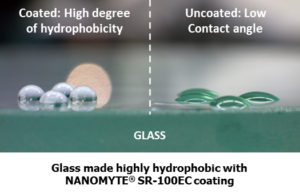 The recently allowed patent application describes durable hydrophobic coating compositions that are highly desirable for numerous applications, as they impart easy-to-clean and stain-resisting properties to surfaces. For aesthetic reasons, there is also a need for a thin, transparent, easy-to-clean coating that does not add excess weight and does not change the appearance of the substrate to be coated. The patented compositions are comprised of functionalized perfluoropolyethers (PFPEs), which are known for their non-stick and lubricating properties. It has been a major technical challenge to incorporate PFPEs into a stable formulation that can lead to a coating with sufficient adhesion to various substrates. The patent claims transparent and homogeneous compositions that overcome the stability and adhesion issues. The compositions result in a micron-thick, durable hydrophobic coating that cannot easily be removed by abrasion, harsh cleaners, or chemicals. The patent is the basis for NEI’s hydrophobic coating products,
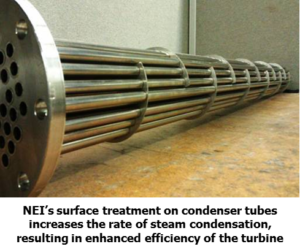
 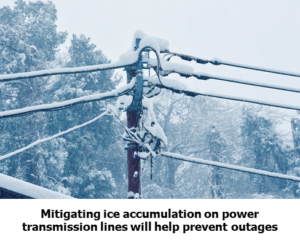 Gains in productivity and efficiency are possible when a coating or surface treatment provides functionalities beyond the usual protective and aesthetic properties. This realization has sparked great interest in functional coatings in recent years for applications that traditionally have not used paints or coatings. A good example is the use of anti-ice coatings on power transmission lines. Mitigating ice accumulation will help prevent power outages, which has a tangible and beneficial economic impact. Another example is the use of a surface treatment to increase the efficiency of power generation turbines.
 While great strides have been made in academic circles to understand the different surface phenomena of these so called ‘smart coatings’, commercial products to date have met with limited success because they are not engineered to meet all of the functional performance requirements that an application may need. For example, commercially available superhydrophobic coatings repel water droplets, but do not prevent the diffusion of water vapor – minimizing moisture ingress is a critical functionality for most protective coatings.
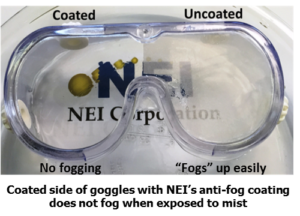 More often than not, many of the functionalities mentioned above need to be integrated into a single coating or surface treatment. For example, a transparent coating that resists finger printing also needs to be scratch resistant and durable. A coating that prevents fogging in eyewear and other transparent surfaces must also be durable and resistant to chemicals. Further, in order to meet the cost criteria, application of the coating must be compatible with conventional coating methods such as spray, dip, brush or flow. Over the past few years, NEI Corporation’s concerted efforts to develop and implement practical, multi-functional coatings are now coming to fruition.
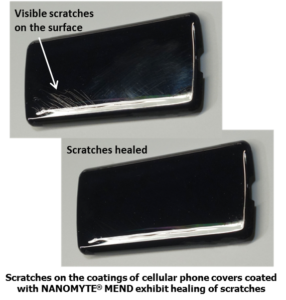 Backed by a bevy of issued and pending patents, NEI has introduced an array of coating products under the registered trade name NANOMYTE®. For example,
 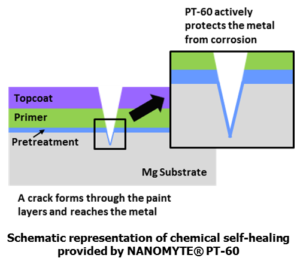 Self-healing principles can also be applied to surface treatments of metals, whereby the pretreatments can mimic the performance of chromate conversion coatings. To this end, NEI has developed a series of pretreatments for different metals where a chemical self-healing mechanism imparts corrosion resistance. For example,
 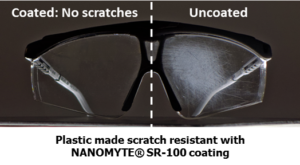 Scratch resistance is a sought-after property for coatings in a variety of applications, such as ophthalmic and sports-wear lenses, automobile and airplane windows. Plastic substrates, such as polycarbonate and acrylic, can scratch easily and lose transparency quickly during daily use and maintenance. Hard and optically transparent coatings for plastic substrates possess a significant market potential. NEI offers a patented (US Patent 9,006,370) transparent, scratch-resistant coating called
  Adhesion enhancement is usually achieved by using adhesion promoters and surface treatment techniques. A recently allowed NEI patent application on adhesion promoter describes a surface pretreatment composition that is chromate‐free. The environmentally-friendly, waterborne pretreatment promotes adhesion between the metal substrate and overlying paint layer by acting as a “double‐sided bonding agent,” while at the same time improving corrosion resistance. The novel composition comprises organo-functional silanes but functions differently from traditional silane treatment. The composition results in a thin film coating having a graded structure, i.e., an inorganic oxide layer that bonds strongly with steel and a loosely crosslinked top layer containing functional groups that can further crosslink with paint overlay. The new technology has value to applicators who paint metal structures, such as bridges, ships, and other steel structures. It is also applicable to industrial painting operations such as coil and spray coatings. The patented chromate‐free pretreatment for steel, offered commercially as